Security has become one of the most critical aspects of operating modern virtualization infrastructures. With the introduction of version 0.9.1.1, PegaProx now includes integrated CIS Benchmark auditing and CVE vulnerability scanning, bringing automated security visibility directly into the virtualization management layer. By combining infrastructure management with continuous security assessment, PegaProx helps administrators detect misconfigurations, identify vulnerabilities, and maintain hardened virtualization environments without relying on external tooling.
Originally designed as a centralized platform for managing Proxmox VE clusters, PegaProx has steadily evolved into a broader datacenter management solution. Previous releases introduced features such as identity integration via EntraID / OIDC and expanded hypervisor support like the recently added XCP-ng integration. With the addition of CIS benchmarking and CVE scanning in version 0.9.1.1, PegaProx now extends beyond operational management and moves deeper into infrastructure security and compliance.
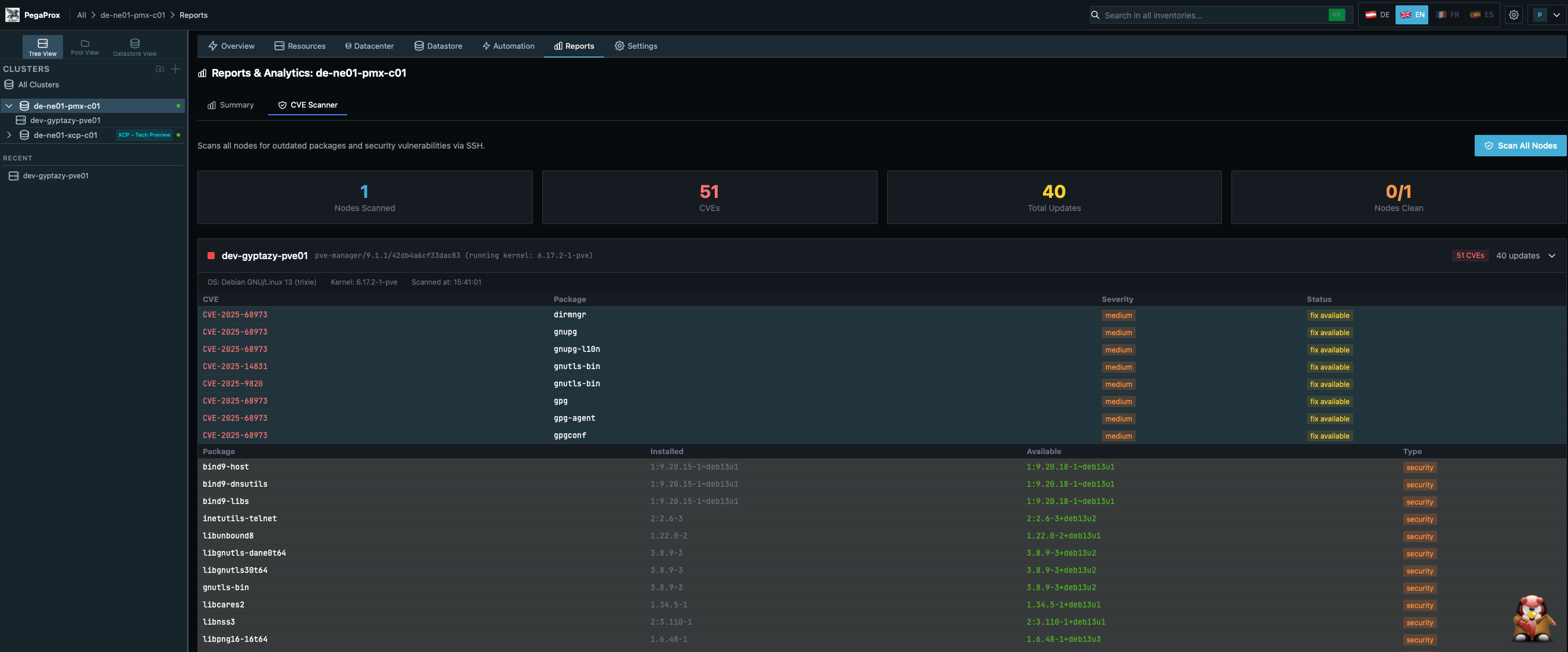
The new security capabilities allow administrators to continuously assess their virtualization infrastructure against widely accepted security standards while simultaneously identifying known vulnerabilities across nodes and services. Instead of treating security as a separate auditing process, PegaProx integrates it directly into the operational workflow of managing clusters and hosts.
Security Challenges in Virtualization Environments
Modern datacenters heavily rely on virtualization platforms to consolidate workloads, increase resource efficiency, and simplify infrastructure management. However, the same abstraction layer that provides operational flexibility can also introduce additional security complexity.
Hypervisors, management interfaces, storage backends, and network components form a highly interconnected environment. A single misconfiguration at the hypervisor level can potentially affect dozens or even hundreds of virtual machines running on the same infrastructure.
Security risks in virtualization environments often arise from several common factors:
- Unpatched hypervisor vulnerabilities
- Insecure default configurations
- Weak access control or authentication mechanisms
- Improper network isolation between workloads
- Lack of continuous vulnerability monitoring
Because virtualization platforms act as the foundation for many workloads, ensuring their security is essential for maintaining the integrity of the entire infrastructure stack.
The Importance of CVE Vulnerability Scanning
Software vulnerabilities are continuously discovered across operating systems, hypervisors, and infrastructure components. These vulnerabilities are typically cataloged as Common Vulnerabilities and Exposures (CVEs), which provide a standardized way to track and reference security issues across the industry.
For administrators operating virtualization environments, keeping track of relevant CVEs can be challenging. New vulnerabilities are published regularly, and determining whether a specific node or software component is affected often requires manual analysis.
Integrated CVE scanning within PegaProx simplifies this process by automatically checking infrastructure components against known vulnerability databases. Administrators gain immediate visibility into potential security risks affecting their virtualization hosts or services.
This allows infrastructure teams to:
- Detect vulnerable components early
- Prioritize patch management based on severity
- Identify affected nodes within clusters
- Reduce the exposure window for critical vulnerabilities
By continuously scanning for known vulnerabilities, PegaProx helps ensure that infrastructure operators remain aware of emerging security risks before they can be exploited.
CIS Benchmarks and Infrastructure Hardening
While vulnerability scanning identifies known software issues, security also depends heavily on correct system configuration. Many security incidents occur not because of software flaws, but due to misconfigured services or insecure default settings.
This is where CIS Benchmarks play a crucial role. Developed by the Center for Internet Security, CIS benchmarks provide detailed configuration guidelines designed to harden operating systems, applications, and infrastructure platforms.
These benchmarks define best practices for secure system configuration, covering areas such as authentication policies, logging configuration, network exposure, and service restrictions.
By auditing systems against CIS benchmarks, administrators can detect deviations from recommended security configurations and identify areas where infrastructure hardening should be improved.
Integrating CIS benchmarking directly into PegaProx allows virtualization administrators to evaluate their clusters against recognized security standards without requiring separate compliance tools.
Integrated Security Visibility in PegaProx
With version 0.9.1.1, PegaProx introduces a dedicated security module that provides centralized visibility into both configuration compliance and vulnerability exposure across managed infrastructure nodes.
Instead of running external scanners or compliance tools, administrators can access security insights directly from the PegaProx interface. The platform aggregates scan results and presents them alongside other operational metrics such as node status, resource utilization, and cluster health.
This integrated visibility allows infrastructure teams to treat security as a continuous operational process rather than a periodic audit.
CVE / Security Scanner
- Package Vulnerability Scan — Per-node CVE scanning via debsecan integration
- CIS Hardening Checks — One-click security audit against CIS benchmarks for Proxmox nodes
- Apply Hardening — Apply recommended hardening settings with a single click
These features allow administrators to quickly identify security weaknesses and immediately apply recommended hardening measures directly from the PegaProx interface.
Security as a Core Part of Infrastructure Operations
Historically, infrastructure management and security auditing were often handled by separate tools and teams. However, as environments become more dynamic and automated, integrating security directly into operational platforms has become increasingly important.
Administrators responsible for virtualization infrastructure need immediate visibility into both operational status and security posture. Combining these perspectives allows teams to detect risks earlier and respond faster to potential threats.
By introducing CIS benchmarking and CVE scanning, PegaProx strengthens its position as a comprehensive datacenter management platform that not only simplifies virtualization operations but also actively supports infrastructure security.
As PegaProx continues to evolve, deeper integrations with security frameworks and automated remediation capabilities will further enhance the platform's ability to maintain secure and resilient virtualization environments.
More information about the platform can be found on the official project website at pegaprox.com or at the GitHub repository at github.com/PegaProx/project-pegaprox. You can also join the community chat in Discord. Ever wondered how PegaProx compares to the official Proxmox Datacenter Manager?