Instead of only using the built in snapshot functionality of Proxmox VE, PegaProx will be able to create and manage snapshots directly on NetApp ONTAP storage systems.
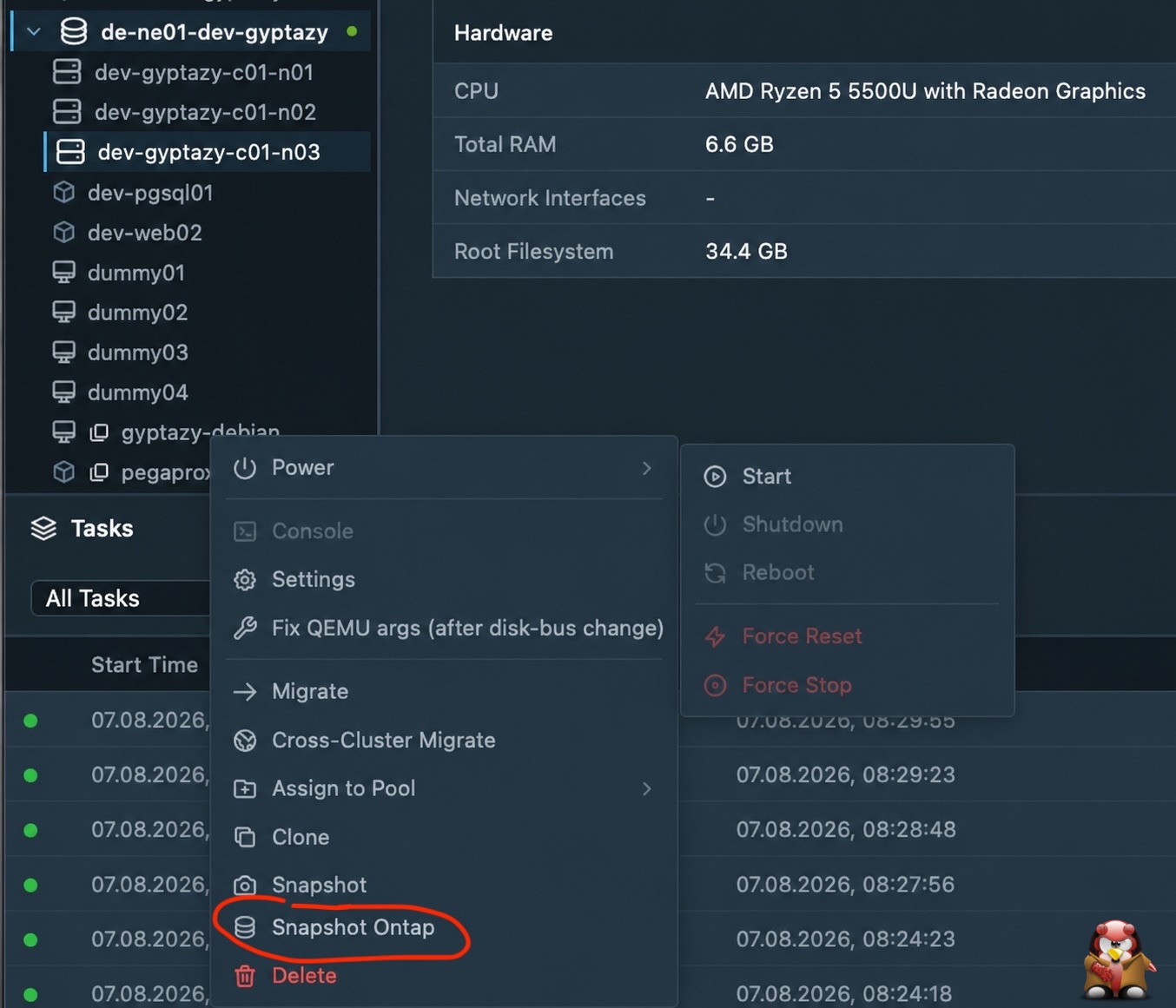
The basic idea is simple. If the storage system already provides powerful snapshot functionality, it makes sense to use it instead of handling everything through the virtualization layer.
Why Storage Based Snapshots?
Proxmox VE already supports snapshots for virtual machines. So why should PegaProx introduce another way of creating them?The main reasons are performance, scalability and storage efficiency.
Snapshots created through the virtualization layer involve different components of the Proxmox VE storage stack. Depending on the storage type and disk format, this can involve QEMU, storage plugins and additional metadata operations.
When the underlying storage system already has its own optimized snapshot technology, these operations can instead be handled directly by the storage.
NetApp ONTAP provides native snapshot functionality on the storage level. Using the REST API, PegaProx can create, query and remove these snapshots directly.
This changes the way PegaProx communicates with the infrastructure.
PegaProx
 |
 +--> Proxmox VE
 |
 +--> NetApp ONTAP API
 |
 v
Native SnapshotFaster Snapshot Operations
One of the biggest advantages is that the snapshot operation is performed directly by the storage system.There is no need to move large amounts of virtual machine data through the Proxmox VE hosts just to preserve the current state of a virtual disk. ONTAP can use its own internal storage structures and metadata to create the snapshot.
This becomes especially interesting when working with large virtual machines.
A virtual machine with several terabytes of data should not automatically result in a complex or expensive snapshot operation on the virtualization hosts.
By moving this task to ONTAP, PegaProx can simply use functionality that already exists on the storage system.
Less Work for Proxmox VE
Another important benefit is reducing the amount of storage work that needs to be performed by the Proxmox VE hosts.The resources of a virtualization host should primarily be used for running virtual machines and containers. If the storage system can perform a certain operation more efficiently, there is no reason to unnecessarily perform that work on the virtualization hosts.
The responsibilities can therefore be separated more clearly.
Proxmox VE
 |
 +--> Virtual Machines
 +--> Containers
 +--> Compute
 +--> Memory
 +--> Networking

NetApp ONTAP
 |
 +--> Storage
 +--> Snapshots
+--> Storage ManagementThis can become particularly useful in larger Proxmox VE environments where snapshots are created for many virtual machines.
Better Scalability
Storage based snapshots can also help PegaProx scale better in larger environments.Instead of seeing a virtual disk only from the Proxmox VE side, PegaProx can understand where the data is actually located.
Proxmox VM
 |
 v
Virtual Disk
 |
 v
Proxmox Storage
 |
 v
NetApp Volume, LUN or NamespaceThis also creates the foundation for much deeper storage integration in PegaProx.
Using the NetApp ONTAP REST API
The integration communicates directly with NetApp ONTAP through its REST API.ONTAP provides API endpoints for managing storage resources, snapshots, Storage Virtual Machines and the different storage protocols.
Creating a snapshot can for example be performed through the volume snapshot API.
POST /api/storage/volumes/{volume.uuid}/snapshotsFor the administrator, the workflow stays simple. The snapshot is managed from PegaProx while PegaProx handles the required communication with Proxmox VE and ONTAP in the background.
NFS, iSCSI, Fibre Channel and NVMe over Fabrics
An important goal of this implementation is to avoid limiting the functionality to a single storage protocol.NetApp ONTAP can provide both file and block storage. This includes NFS as well as iSCSI, Fibre Channel and NVMe over Fabrics.
For PegaProx, the architecture can therefore look like this:
NetApp ONTAP
 |
 +--> NFS
 |
 +--> iSCSI
 |
 +--> Fibre Channel
 |
 +--> NVMe over Fabrics
 |
 v
Proxmox VE ClusterA Proxmox VE host might access its storage through NFS, iSCSI, Fibre Channel or NVMe over Fabrics. PegaProx still communicates directly with the ONTAP management API to control the snapshot on the storage system.
Making PegaProx Storage Aware
Virtualization platforms usually try to hide as much of the underlying storage infrastructure as possible.This is useful because administrators normally do not want to care about every technical detail of the storage backend when managing a virtual machine.
However, this abstraction can also mean that useful features of enterprise storage systems are never used.
With PegaProx, I want to take a slightly different approach.
Instead of treating every storage system in exactly the same way, PegaProx can understand which storage platform is being used and make use of features that are available on that platform.
For NetApp ONTAP, native snapshots are one of these features.
Administrators still get centralized management through PegaProx, but advanced functionality of the storage system does not have to disappear behind the virtualization layer.
Benefits at a Glance
Compared to only using snapshots through the virtualization layer, the storage based approach provides several interesting advantages.- Faster snapshot creation by using the native capabilities of the storage system
- Less work for Proxmox VE hosts because snapshot operations are handled by ONTAP
- Better scalability for environments with many virtual machines or large virtual disks
- Efficient snapshots using the native snapshot technology provided by ONTAP
- Support for NFS, iSCSI, Fibre Channel and NVMe over Fabrics
- Central management through PegaProx
- Direct integration with the NetApp ONTAP REST API
- A foundation for additional storage functionality in the future
More Than Just Snapshots
For me, one of the most interesting parts of this implementation is not simply adding another snapshot button to PegaProx.The interesting part is the storage integration behind it.
Once PegaProx understands that a Proxmox VE storage belongs to a specific ONTAP system and knows how the virtual resources are connected to the underlying storage resources, many more possibilities become available.
Storage based snapshots are therefore only the first step towards making PegaProx more aware of the underlying storage infrastructure.
In the future, the same integration could potentially be used for other storage operations such as snapshot management, cloning, replication and additional storage automation.
The important change is that PegaProx does not have to see storage only as a place where virtual disks are stored.
Instead, it can understand the storage platform behind these disks and make use of its native functionality.
What Comes Next?
The NetApp ONTAP integration is currently under development for PegaProx where I try to finish a first draft for my PegaProx talk at the FrOSCon 2026, including a live demonstration.My goal is to provide a simple workflow where administrators can create and manage storage based snapshots directly through PegaProx. PegaProx takes care of communicating with Proxmox VE and the underlying NetApp ONTAP storage system.
For smaller environments, the snapshot functionality that is already included in Proxmox VE remains a perfectly good solution.
But when Proxmox VE is connected to an enterprise storage system such as NetApp ONTAP, I think it makes sense to also use the functionality that is already available directly on the storage.
With this extension, PegaProx starts connecting these two worlds. Proxmox VE continues to handle the virtualization side while NetApp ONTAP handles storage operations that are better performed directly on the storage system.
For me, this is also an important foundation for adding deeper storage integration to PegaProx in the future.