PegaProx is designed to be the central control point for modern Proxmox VE based datacenters. It brings together everything administrators need to manage complex infrastructures in a single, clear interface, similar to what many operators already know from established enterprise virtualization platforms. Instead of switching between clusters, nodes, storage views, and monitoring tools, PegaProx provides a real unified platform that delivers full visibility and precise control over the entire environment - watch the demo, now! This article is an independent technical overview of PegaProx. The official product website is pegaprox.com.
Virtualization operators often face recurring challenges in day to day operations. Keeping track of resource usage across multiple clusters, identifying overloaded nodes before performance degrades, coordinating maintenance windows, and ensuring workloads remain highly available can quickly become complex. As environments grow, manual processes and fragmented tooling increase the risk of configuration drift, human error, and unexpected downtime. PegaProx addresses these issues by centralizing cluster management, providing real time metrics, and enabling intelligent automation that reduces operational overhead.
Built by a small and passionate team of developers (Nico Schmidt, Marcus Kellermann and Laura Weber), PegaProx focuses on solving real world operational problems that administrators encounter daily. From managing multiple clusters as a single logical unit to intelligently distributing workloads based on live resource data, every feature is designed with scalability, reliability, and clarity in mind. The goal is to make enterprise grade Proxmox management accessible without unnecessary complexity, while offering more advanced capabilities than many existing solutions currently provide.
With support for cross cluster migrations, live workload monitoring, VM resource balancing, high availability mechanisms, CPU alignment for safe live migrations, and granular role based access control, PegaProx is suitable for both growing lab environments and large scale production deployments. It allows operators to react quickly to failures, plan capacity with confidence, and maintain consistent policies across all clusters. As infrastructure requirements evolve, PegaProx scales alongside your environment and helps ensure that operational complexity does not grow faster than your platform. Some of those tools like VM resource balancing, CPU alignment for safe live migrations and more you might already know - and they now all come in a unified interface!
Feature Overview
PegaProx provides a comprehensive set of features designed to simplify and standardize the management of Proxmox based infrastructures. Each capability focuses on reducing operational complexity while giving operators full control over clusters, nodes, storage, and virtual machines.
- Unified multi-cluster Management
- Node and Cluster Monitoring
- User & Group Management
- Semi-automated Node Security Patch Management
- Cross Cluster Migration
- Virtual Machine & Container Management
- CPU Alignment over Nodes for safe VM live-migrations (ProxCLMC)
- Intelligent Load Balancing for VMs (ProxLB)
- Intelligent Load Balancing for Storage (ProxLB)
- Snapshot Management & Cleanup in Cluster Scope (ProxSnap)
- High Availability and Failover
- Tenancy Management
- And much more...
Unlike other unified solutions, PegaProx provides integration of the often missed enterprise features. Together, these features allow operators to manage growing Proxmox environments efficiently, maintain consistent operational standards, and focus on delivering reliable services rather than handling repetitive administrative tasks.
Installation and Configuration
The installation and initial configuration of PegaProx are designed to be straightforward and fast, allowing operators to start managing their Proxmox infrastructure within minutes. The platform follows a guided setup process that focuses on connecting existing environments first and then gradually enabling advanced features.
Installation of PegaProx
PegaProx can currently be installed and used in three different ways, depending on the target environment and operational requirements. All installation methods provide the same feature set. The easiest way to get started is by using one of the ready-to-use appliances. These appliances are preconfigured and can be imported directly into an already existing Proxmox VE environment.
PegaProx is shipped as both an LXC container appliance and a virtual machine appliance. The LXC appliance is lightweight and quick to deploy, making it well suited for smaller environments or test setups. However, due to current Proxmox limitations, live migration of LXC containers is not supported, which can be a drawback in highly available environments. To address this limitation, PegaProx is also provided as a VM appliance. This option supports Proxmox features such as live migration and is therefore recommended for production environments where high availability is required. Both appliance types only need to be imported into an existing Proxmox VE cluster and can be started immediately.
The ready-to-use appliances can be found at cdn.gyptazy.com (an official mirror) at:
Another installation option is to use the deployment script provided by the project. This script installs PegaProx on any already existing system, such as a virtual machine, a bare-metal host, or other supported Linux environments. This approach offers more flexibility while still providing a guided installation process.
For advanced users, a fully manual installation method is also available. This option is intended for custom environments and requires deeper knowledge of Linux system administration and Proxmox VE. In short, it's simply about running the following commands:
apt-get update && apt-get -y install git
git clone https://github.com/PegaProx/project-pegaprox.git
cd project-pegaprox
bash deploy.sh
cp pegaprox_multi_cluster.py /opt/PegaProx/
cp web/index.html /opt/PegaProx/web/
systemctl start pegaprox
systemctl enable pegaprox
To get quickly on track, I've also added Docker (container) support to PegaProx. This allows developer to quickly create a Docker image and to perform further tests. As a result, you can simply create an image from scratch by running the following commands
# Clone the repository
git clone https://github.com/PegaProx/project-pegaprox.git

# Build Docker Image
docker build -t pegaprox .

# Run the image
docker run -p 5000:5000 pegaprox
Additionally, you can also directly fetch ready to use Docker images from my container image registry at:
cr.gyptazy.com/pegaprox/pegaprox:latest
Configuration of PegaProx
When it comes to the configuration, the first step is to add your Proxmox clusters. Therefore, you can simply open your browser at the PegaProx webinterface at https://pegaproxhost:5000. If not mofified, it comes with the following default setup:
Host: IP/HOSTNAME
Port: 5000
User: pegaprox
Password: admin
Clusters are connected using SSH (not all features are available in the Proxmox API) and afterwards also the API, allowing PegaProx to securely communicate with each environment. There is no practical limit on the number of clusters that can be connected, making it suitable for both small setups and large, distributed infrastructures. Once connected, cluster information, nodes, and virtual machines become immediately visible in the unified dashboard.
After clusters are connected, policies can be configured to match your operational requirements. This includes defining load balancing rules to distribute workloads efficiently, setting up high availability policies to ensure service continuity, and configuring user permissions to control access. These policies provide a consistent operational baseline across all clusters and help reduce manual intervention.
With the core configuration in place, PegaProx can be used to monitor and manage the entire infrastructure from a single interface. The unified dashboard provides real time insights into resource usage, system health, and virtual machine status. Operators can perform daily management tasks, respond to alerts, and troubleshoot issues without switching between different tools or cluster views.
As your infrastructure grows, PegaProx scales effortlessly alongside it. New clusters and nodes can be added at any time without disrupting existing operations. The platform automatically integrates new resources into the global view, ensuring that management remains consistent and efficient as the environment evolves.
Usage of PegaProx
PegaProx is designed to support real world enterprise workflows where stability, predictability, and operational efficiency are critical. Beyond basic management tasks, it focuses on features that operators typically miss when running Proxmox at scale. These features help reduce manual effort, minimize risk during daily operations, and bring established enterprise practices into Proxmox based environments in a manageable and transparent way.
VM and Storage Resource Scheduler and Balancing
One of the most requested enterprise features when migrating to Proxmox is intelligent scheduling and balancing of virtual machines across nodes. In many environments, workloads grow organically, leading to uneven resource usage, overloaded nodes, and underutilized hardware. Manual rebalancing quickly becomes time consuming and error prone.
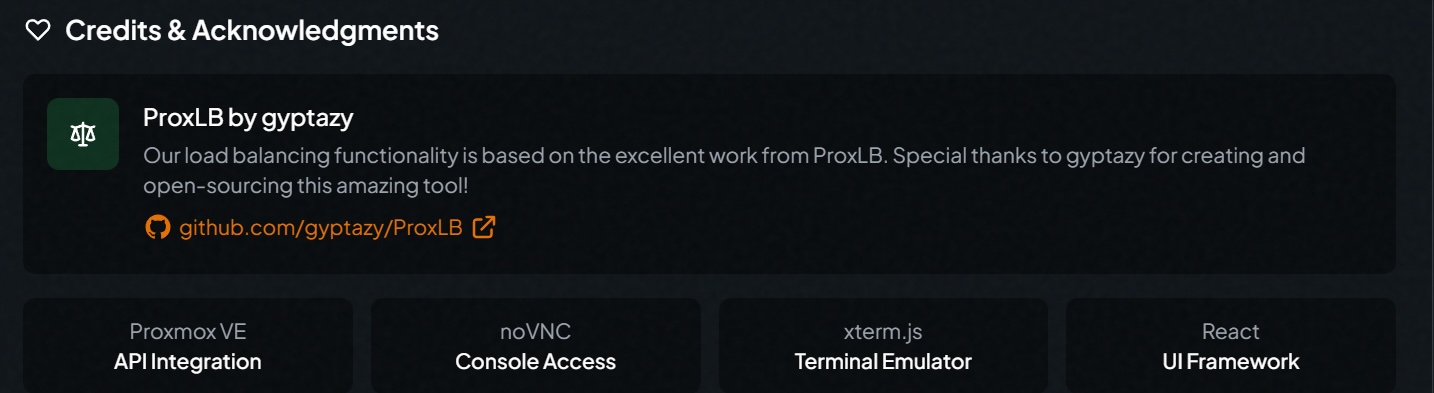
PegaProx integrates an automated VM resource scheduler that continuously evaluates resource usage across all nodes and clusters. Based on defined policies, virtual machines can be placed or migrated to ensure balanced CPU, memory, and storage utilization. This approach builds on proven concepts already known from solutions like ProxLB and finally brings them into a fully integrated user interface. Operators gain the benefits of automated scheduling while retaining full visibility and control over placement decisions.

From a personal perspective, it is especially rewarding to see these concepts reused and extended within PegaProx, as the VM balancing logic builds directly on my ProxLB project and brings proven scheduling ideas to a broader Proxmox based audience through a modern and integrated platform.
Maximum CPU Compatibility Level Across All Nodes
Live migration is a core feature that operators rely on every day, yet it is also one of the easiest ways to introduce instability if CPU compatibility is not handled carefully. In real world clusters, hardware is rarely homogeneous. Nodes are added over time, CPU generations change, and available instruction sets differ. Simply using a host CPU type is often not viable, especially when running mixed workloads or Windows virtual machines.
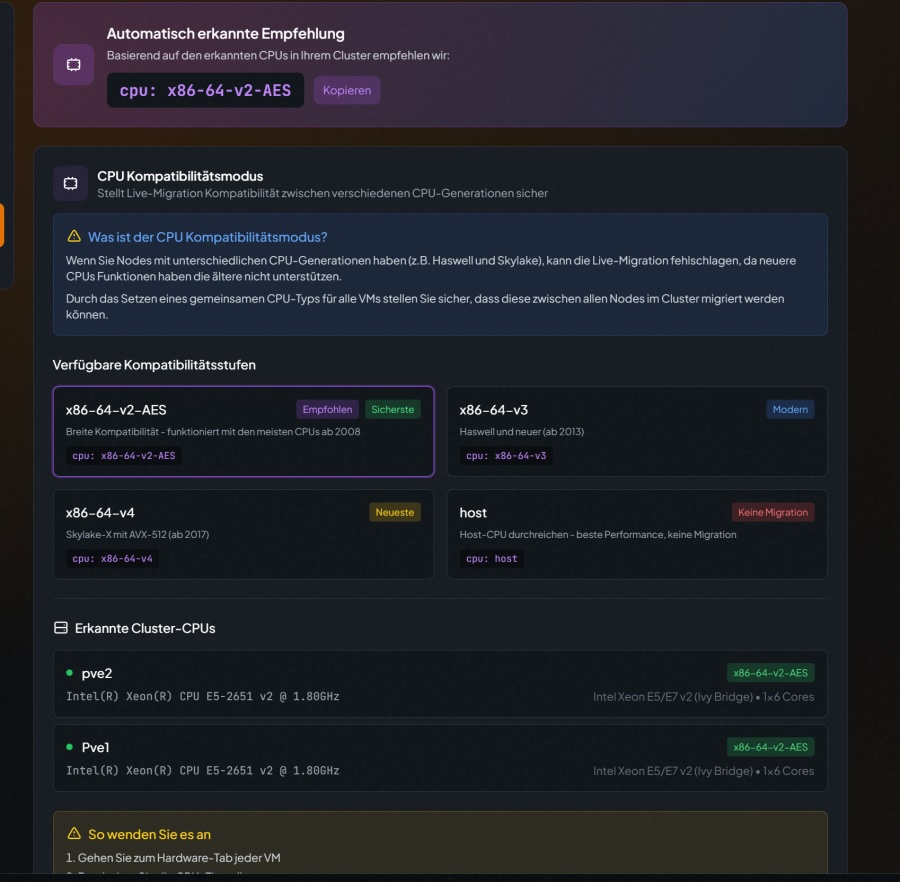
PegaProx addresses this challenge by automatically detecting the available CPU features across all nodes in a cluster and determining a safe and optimal baseline CPU type. This ensures that virtual machines remain compatible with every node, making live migrations reliable and predictable. By removing the need for guesswork and manual testing, operators can confidently enable migrations without risking downtime or performance regressions. This is pretty similar integrated to my ProxCLMC project.
Proxmox VE Node Patch Management
Keeping Proxmox VE nodes up to date is a critical security and stability requirement, yet it is often handled with external tools or manual processes. Many operators rely on Ansible or custom scripts, while built in tools typically only show pending updates without providing a structured way to apply them safely across a cluster.
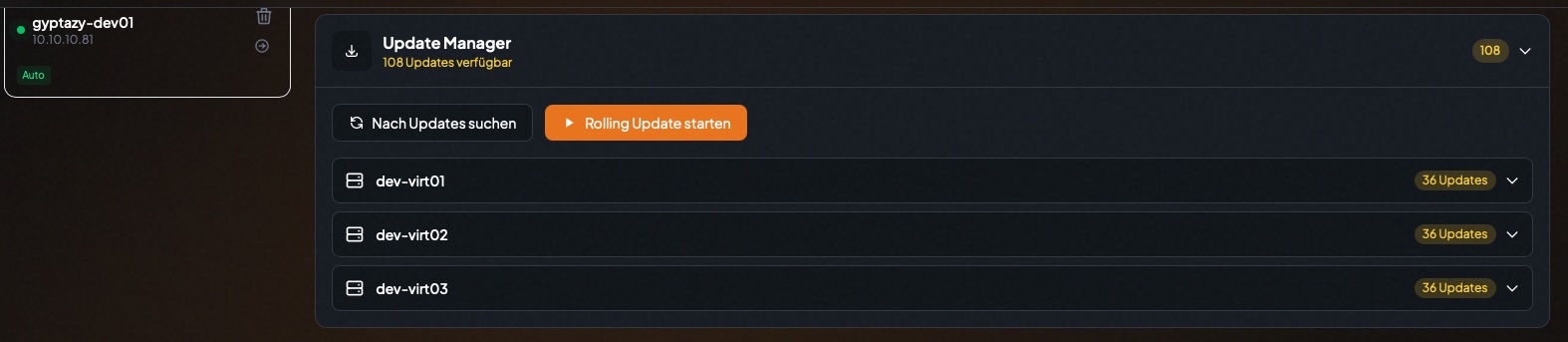
Unlike many other solutions for Proxmox based management, PegaProx does not only show pending updates. PegaProx also allows you to update nodes directly from the interface, including handling of all upcoming tasks. And the best? Without switching any window or context! Unfortunately, this requires ssh access to the nodes (there is no API endpoint and upstream rejected to add this).
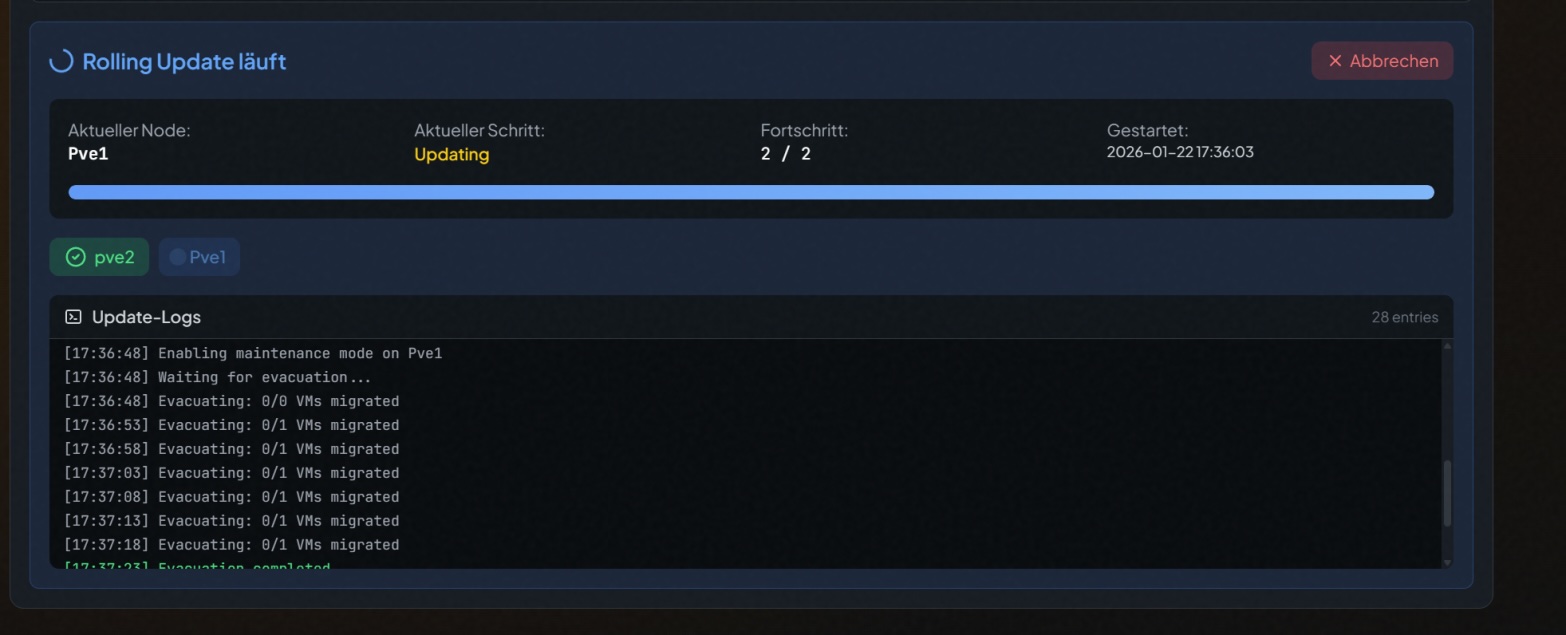
PegaProx fills this gap by providing centralized visibility into security and system updates for all connected nodes. Operators can review pending patches, group nodes logically, and perform upgrades in a controlled and repeatable way. This aligns with how patch management is handled in enterprise environments, where consistency, auditability, and ease of use are essential. By integrating patch management directly into the platform, PegaProx makes administrators feel at home while significantly reducing the operational overhead of keeping systems secure and up to date.
Live VM Migration over Clusters
Live migration is one of the most important capabilities in modern Proxmox environments. It allows virtual machines to be moved between nodes or even clusters without noticeable downtime, enabling maintenance, load balancing, and failure avoidance while keeping services available. PegaProx places live migration at the center of daily operations and makes it accessible through a single, consistent interface.
All live migration tasks are fully managed from within PegaProx. Operators can initiate, monitor, and control migrations directly from the unified dashboard without switching between nodes or cluster views. This centralized approach simplifies workflows and provides clear visibility into the current state and progress of each migration.
In real world environments, live migrations often fail due to common and well known issues. Virtual machines may still have ISO images attached, storage may not be accessible on the target node, or configuration details may prevent a safe migration. Instead of starting a migration blindly and only reporting a failure after the fact, PegaProx actively checks for these conditions in advance.
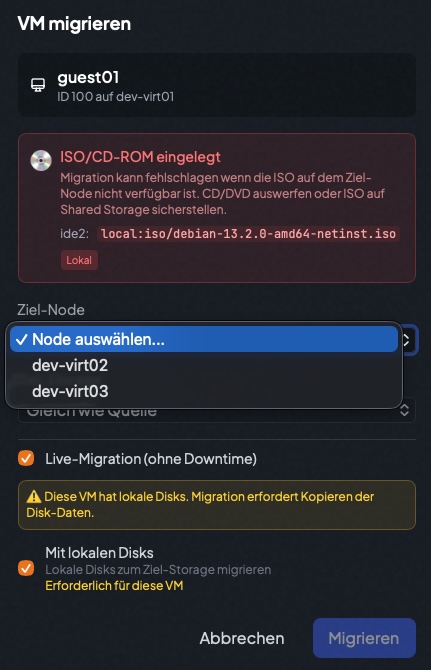
When potential issues are detected, PegaProx presents clear and understandable warnings before the migration is started. This gives operators the opportunity to resolve problems proactively and avoids unnecessary interruptions. By guiding users through required adjustments, the platform reduces frustration and builds confidence in the migration process.
By combining centralized control, proactive validation, and clear feedback, PegaProx turns live migration into a predictable and reliable operation. The focus is not only on technical correctness but also on operator comfort, ensuring that migrations can be performed safely, repeatedly, and with full trust in the outcome.
Snapshot Management & Cleanup in Cluster Scope
PegaProx provides a centralized snapshot management view on a per-cluster basis, allowing administrators to see all snapshots across the selected Proxmox VE cluster in one place. Instead of inspecting individual virtual machines one by one, snapshots are aggregated into a single, clear overview.
All snapshots are automatically sorted by their creation date, starting with the oldest ones. This makes it easy to quickly identify outdated or forgotten snapshots that often consume unnecessary storage and increase operational risk over time. From this centralized view, snapshots can be deleted directly without the need to manually validate or open each virtual machine to check for existing snapshots. This significantly reduces the effort required for regular snapshot maintenance and cleanup tasks.
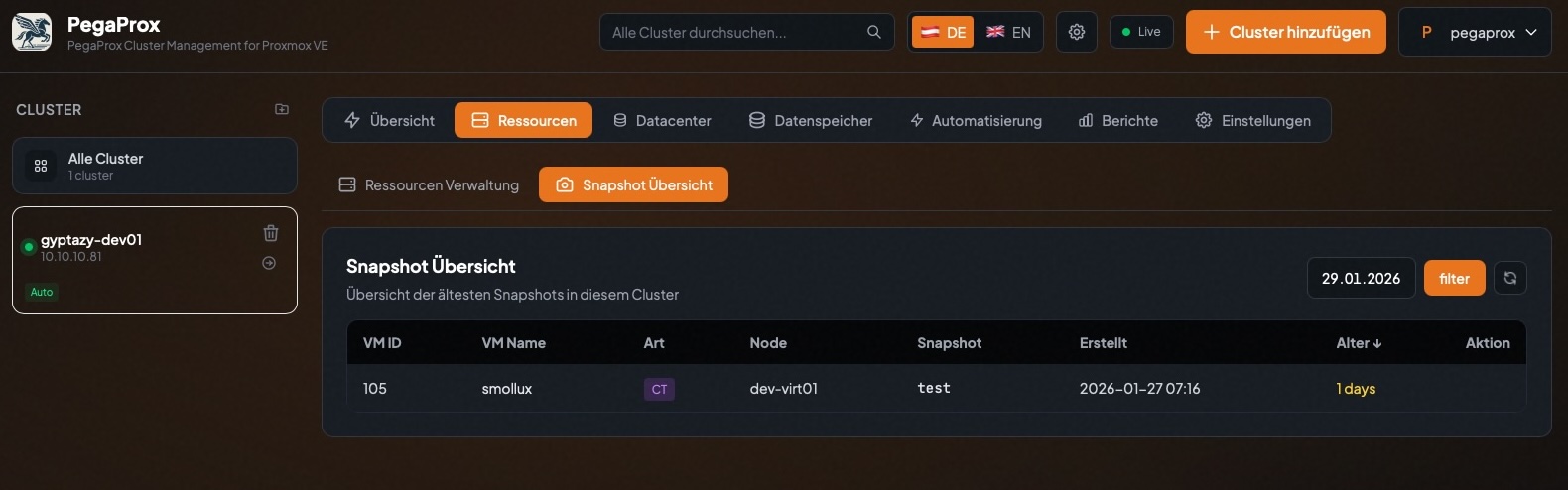
By eliminating fragmented workflows and manual checks, snapshot handling becomes faster, safer, and far more efficient—especially in larger clusters with many virtual machines.
This functionality is based on my upstream contribution to PegaProx, introducing the ProxSnap feature. The integration brings cluster-wide snapshot visibility and cleanup capabilities directly into the PegaProx platform.
User, Groups- and Tenancy Support
PegaProx is built with multi user and multi tenant environments in mind, where clear separation of responsibilities and controlled access are essential. The platform provides full support for users, groups, and tenancies, allowing organizations to model their internal structures and operational workflows in a clean and scalable way.
Access control in PegaProx is based on a fine granular role and permission system. Users can be assigned to one or more groups, and groups can be linked to specific tenancies. This makes it possible to define who is allowed to access which part of the infrastructure, without relying on broad or overly permissive roles.
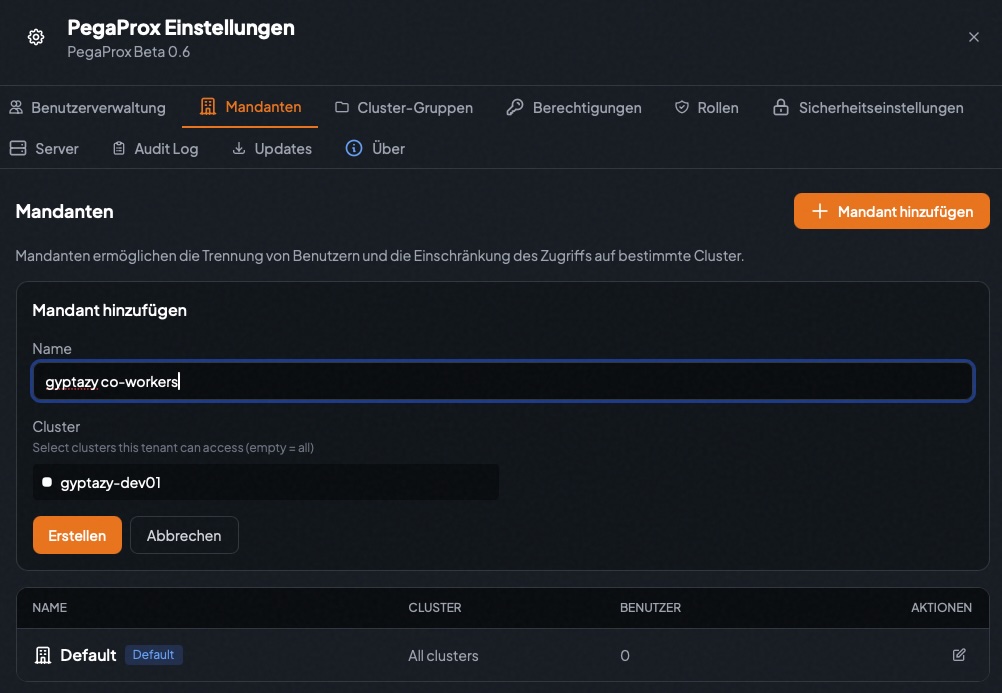
Permissions can be scoped precisely to clusters, individual nodes, or even single virtual machines. This allows operators to grant access only where it is required, for example limiting a team to manage a dedicated cluster, allowing read only access to certain nodes, or giving full control over specific virtual machines while keeping the rest of the environment isolated.
The access control system does not stop at visibility. Management capabilities for nodes and virtual machines are also governed by the same fine granular ACL rules. Actions such as starting or stopping virtual machines, performing migrations, changing configurations, or managing node maintenance states can be allowed or denied based on assigned roles.
By combining users, groups, tenancies, and role based access control into a single coherent system, PegaProx enables secure collaboration across teams and customers. This approach aligns with enterprise security expectations and ensures that every action within the platform is intentional, auditable, and limited to the appropriate scope.
Themes
Theming is often considered a minor detail, yet it is a frequently requested feature within the Proxmox community. Many operators spend a significant amount of time working in management interfaces every day, and a comfortable and visually consistent environment can have a noticeable impact on usability and overall satisfaction.
PegaProx addresses this request by providing built in theme support as part of the platform. Users are not limited to a single fixed appearance but can choose from a set of predefined themes that adjust colors, contrast, and overall visual style. This allows operators to select a theme that fits their preferences, working conditions, or organizational standards.
The availability of multiple themes makes it easier for users to feel comfortable and confident while using the interface, especially during long operational sessions. It also helps teams align the look and feel of the platform with existing workflows or corporate design guidelines.
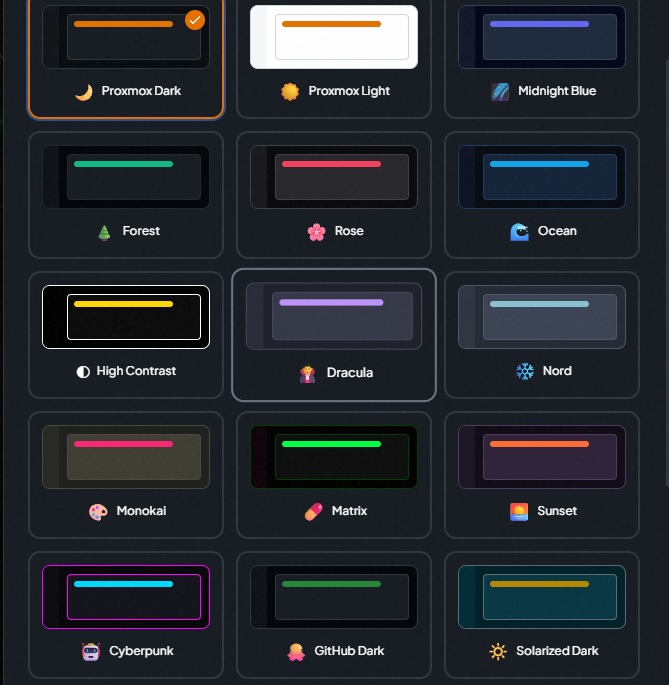
While theming is not a functional requirement, it reflects the overall philosophy behind PegaProx. Attention to such details shows a strong focus on user experience and community feedback, ensuring that the platform not only delivers powerful enterprise features but also remains pleasant and intuitive to use on a daily basis.
PegaProx as the real Datacenter Manager
All of these capabilities clearly demonstrate that PegaProx is not just another monitoring or visualization tool, but a true datacenter manager for Proxmox VE based clusters and nodes. It directly addresses the long standing gap that many operators have experienced over the years: the lack of a unified management system that goes beyond displaying metrics and statistics and instead enables real, day to day operations from a single control plane.
PegaProx brings together what was previously fragmented across scripts, external tools, and manual processes. It allows operators to manage clusters, nodes, storage, and virtual machines centrally, while actively supporting operational tasks such as live migrations, workload balancing, maintenance workflows, and patch management. This operational focus makes it possible to run Proxmox environments in a predictable, enterprise ready manner.
By combining missing enterprise features such as automated resource scheduling comparable to DRS, cluster wide CPU compatibility handling similar to EVC, centralized node patch management, and a fine granular permission and role system, PegaProx creates a level of control that operators expect from mature datacenter platforms. Permissions can be defined from clusters down to individual nodes and virtual machines, enabling secure multi user and multi tenant operations without sacrificing flexibility.
The unified point of view across the entire infrastructure is a core strength of PegaProx. multi-cluster environments can be managed as a single logical system, policies can be applied consistently, and operational decisions can be made based on real time data rather than assumptions. At the same time, the platform remains accessible and scalable, supporting everything from single node installations to local clusters and large multi-cluster deployments spanning multiple regions.
Given this approach and feature set, PegaProx is well positioned to become the go to solution for Proxmox based setups of all sizes. It brings together enterprise grade functionality, operational safety, and ease of use in a way that finally makes Proxmox VE feel like a fully integrated datacenter platform, ready for both current demands and future growth.