Starling (not to mix up with Starlink) is a lightweight and minimalist ActivityPub server for the Fediverse. Written entirely in PHP and powered by SQLite, Starling makes it possible to run your own decentralized social network on shared hosting, low-resource VPS systems, or simple self-hosted environments.
The Fediverse is a decentralized social networking ecosystem based on open standards such as ActivityPub. Instead of depending on a single centralized company, the Fediverse consists of thousands of independently operated servers that communicate with each other. Users on one server can follow and interact with users on completely different platforms while remaining connected to the same global social network.
Popular Fediverse platforms include Mastodon, GoToSocial, Misskey, PixelFed, Pleroma, and many others. Each project follows its own philosophy and feature set, but all of them share the same core idea: giving users control over their own infrastructure, communities, and data.
Most existing Fediverse platforms are designed for medium to large communities and therefore require more advanced infrastructure, databases, caching systems, and worker processes. However, there has been growing interest in lightweight alternatives that focus on simplicity and personal hosting.
Projects such as snac demonstrated that running a personal Fediverse server does not require enterprise-style deployment setups or heavy backend infrastructure. This is exactly where Starling positions itself.
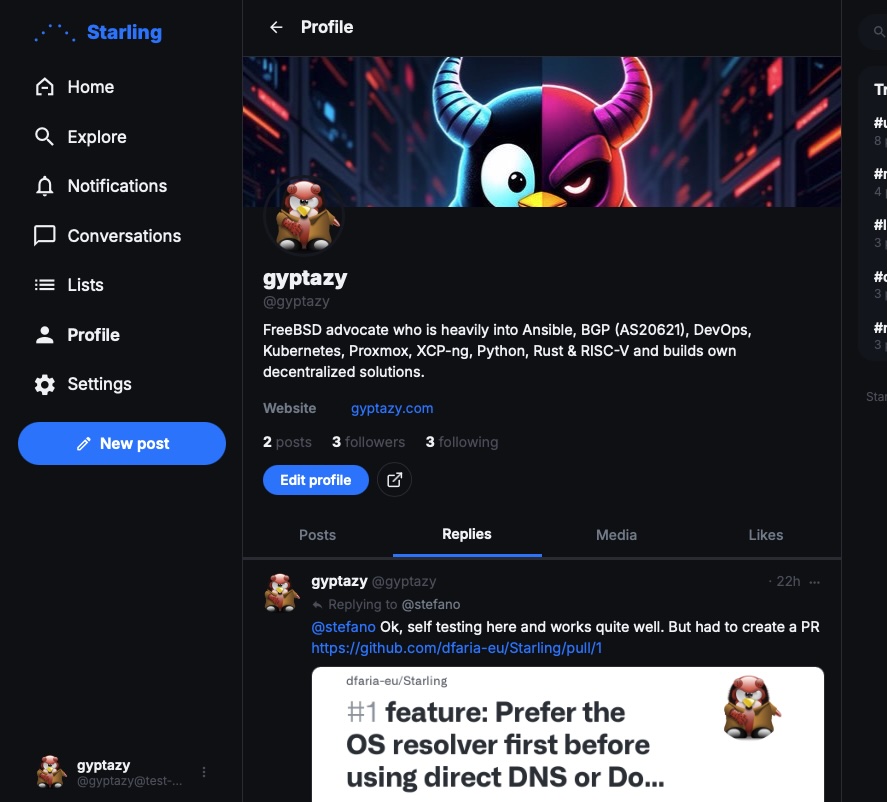
Starling, created by Domingos Faria, is designed to make Fediverse hosting accessible to everyone. The project focuses on simplicity, low resource usage, and straightforward deployment. From a usability perspective, the Twitter-like interface makes the platform feel familiar and approachable, especially for users who are new to decentralized social networking.
Unlike many larger Fediverse platforms, Starling does not require PostgreSQL, Redis, Docker, background workers, or complex orchestration systems. Instead, it runs as a traditional PHP application with SQLite as its database backend. This allows Starling to operate efficiently even on standard shared hosting providers with minimal system requirements.
Because the project is still relatively new, some rough edges and bugs are expected. Nevertheless, development is active and the project already receives community contributions. I also submitted my own first patch to improve the software.
The name “Starling” is inspired by the coordinated movement patterns of starling bird murmurations. The project reflects the same ideas of decentralization, lightweight communication, independence, and distributed interaction — all fundamental principles of the Fediverse itself.
What is Starling?
Starling is a lightweight ActivityPub server built with PHP and SQLite. It provides a Mastodon-compatible API, a built-in web interface, federation support, and administrative tools while intentionally avoiding unnecessary complexity.
The project is particularly suited for:
- Personal Fediverse servers
- Small online communities
- Shared hosting environments
- Low-resource VPS systems
- Users looking for simple deployment and maintenance
Despite its lightweight architecture, Starling still supports important Fediverse functionality including:
- ActivityPub federation
- Posts and replies
- Followers and following
- Likes and boosts
- Mastodon-compatible clients
- Federation relays
- Delivery queues
- Administrative tools
Starling can federate with Mastodon, GoToSocial, Misskey, Pleroma, PixelFed, and other ActivityPub-compatible platforms.
Why Starling Matters
One of the biggest challenges for newcomers to the Fediverse is infrastructure complexity. Running a traditional Mastodon server often requires multiple services, Redis, PostgreSQL, Sidekiq workers, object storage, and significant system resources.
Starling dramatically lowers this barrier to entry. Since it only requires PHP and SQLite, users can deploy their own Fediverse instance on inexpensive hosting plans without managing a dedicated server environment.
This makes Starling particularly interesting for hobbyists, developers, privacy enthusiasts, and small communities who want to participate in decentralized social networking without maintaining complex infrastructure. The best? It also comes with a gread admin webinterface that makes it easy to use and configure to everyone!
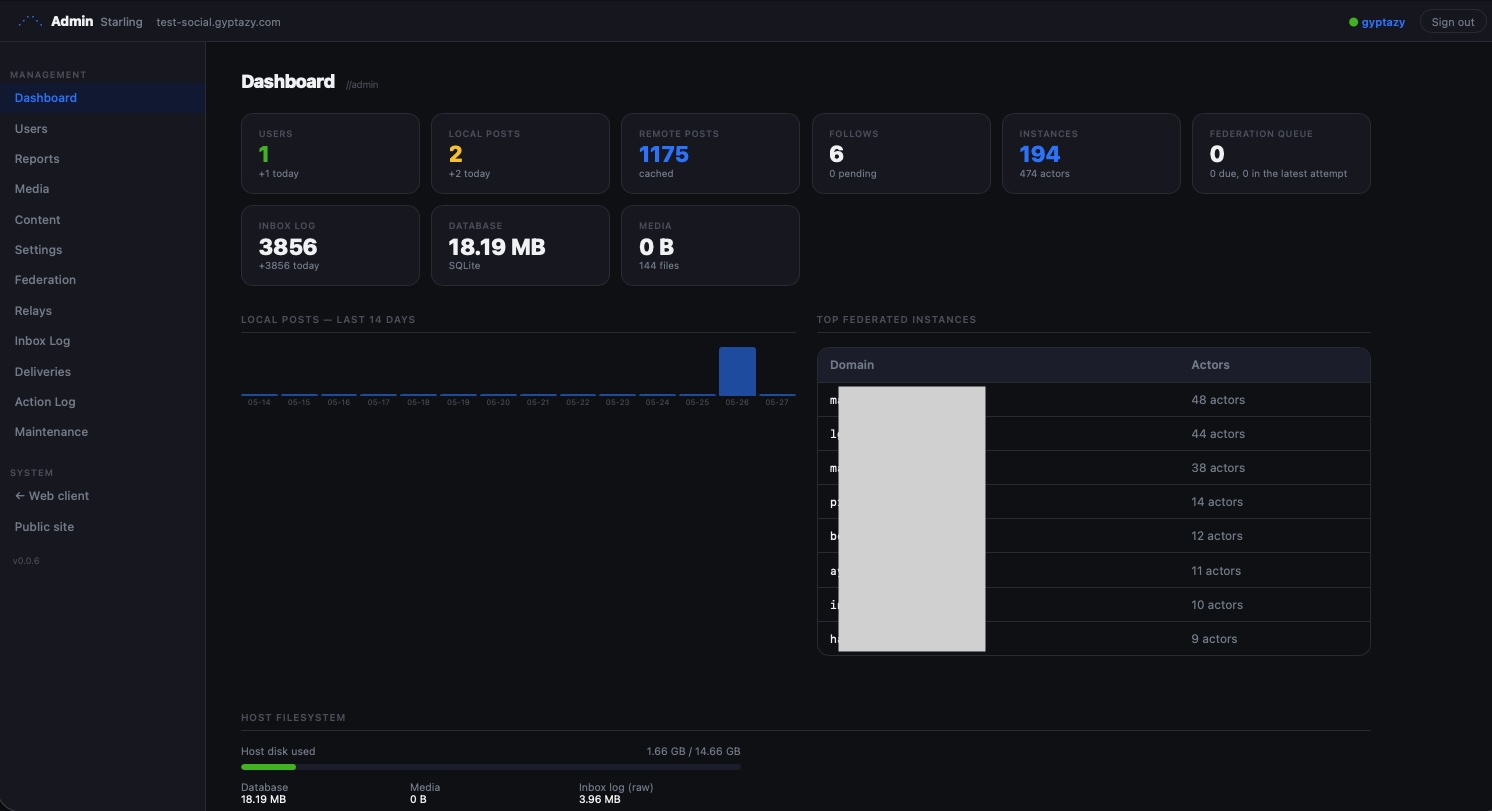
For many users, Starling represents one of the easiest ways to self-host a fully federated social platform while still remaining connected to the wider ActivityPub ecosystem.
Starling Features
- Lightweight PHP-based architecture
- SQLite database support
- ActivityPub federation
- Mastodon-compatible API
- Simple installation process
- Runs on shared hosting providers
- Minimal resource consumption
- Open-source and self-hostable
- Modern Twitter-like user interface
Installation
Starling is intentionally designed to be extremely simple to deploy. Because it only requires PHP and SQLite, the software can run on shared hosting providers, small VPS systems, and low-resource environments without additional infrastructure services.
Shared Hosting Installation
To install Starling on shared hosting, simply download the project ZIP archive and upload the files to your hosting environment using FTP or SFTP. Afterwards, adjust the configuration inside config/config.php to match your domain and hosting setup.
VPS Installation
If you are running your own VPS server, you can quickly install Starling via SSH inside your web server’s document root:
git clone https://github.com/dfaria-eu/Starling.git
mv Starling/* .
vi config/config.php
Inside the configuration file, adjust settings such as:
- Instance name
- Domain name
- Administrator email address
- Federation settings
Afterwards, open your website in the browser.
Starling automatically redirects new installations to /install, where you can complete the setup process and create your first user account.
Final Thoughts
Starling is an exciting addition to the growing ecosystem of lightweight Fediverse software. By focusing on simplicity, accessibility, and low system requirements, it opens decentralized social networking to users who may previously have avoided self-hosting due to operational complexity.
While the project is still young and evolving, its lightweight design, PHP-based architecture, and shared-hosting compatibility make it one of the most approachable ActivityPub servers currently available.
For anyone looking to explore the Fediverse, host a personal social platform, or experiment with ActivityPub without deploying a large infrastructure stack, Starling is definitely a project worth watching. The great interface design makes it easy to use and reminds a lot to the former Twitter and Bsky layout. Wondering how many Starling instances are already known and available within the fediverse? Here you can find all instances that already run Straling!