Search results for tag #openbsd


Surprise! 🎉 #OpenBSD 8.0 is released! Happy release day!  🐡
https://www.openbsd.org/80.html
This is the 61st release of OpenBSD. Now get to upgrading/installing on all your machines. 
Announcement mail: https://marc.info/?l=openbsd-announce&m=179245843570316&w=2

Contributing code to the BSDs.
OpenBSD uses CVS. Like git but from yestercentury. You type out diffs by hand & when they hear the noise of your typewriter they send someone around to check. It better be good this time.
With NetBSD it’s the same but different. You have to join a telephone tree first, but not on a Thursday because Martha leaves early to pick up the kids then.
Oh, & C only. But K&R C, not that modern Borland stuff.


Latest 𝗩𝗮𝗹𝘂𝗮𝗯𝗹𝗲 𝗡𝗲𝘄𝘀 - 𝟮𝟬𝟮𝟲/𝟭𝟬/𝟭𝟵 (Valuable News - 2026/10/19) available.
https://vermaden.wordpress.com/2026/10/19/valuable-news-2026-10-19/
Past releases: https://vermaden.wordpress.com/news/
#verblog #vernews #news #bsd #freebsd #openbsd #netbsd #linux #unix #zfs #opnsense #ghostbsd #solaris #vermadenday

So if wine comes to OpenBSD I may fire up my gaming rig to play on it again, since the AMD GPU support is already there.
Hopefully that was the last big uncm(4) parch for a while. Should make it spec compliant.
I think it's about time for some #OpenBSD #80HYPE 
Clang/LLVM 22 is now OpenBSD's base compiler on clang architectures, including updated libc++{,abi}, compiler-rt & libunwind support libraries.
https://bsd.network/@brynet/116658062479940402
OpenBSD/sparc64 switches to Clang by default! This was the last significant architecture to switch. This makes OpenBSD the only operating system to support sparc64 with a modern toolchain.
https://bsd.network/@brynet/117130130536792528
Since 7.9, Jonathan Gray (jsg@) has continued to update the drm graphics stack (inteldrm/radeondrm/amdgpu) bringing OpenBSD 8.0 to Linux 6.18.y/6.18.53, adding driver support for Intel Arc A-Series (DG2/Alchemist) cards.
Increased KVA (kernel virtual addresses) on amd64 (to 512G) now allows mapping more than 4G of VRAM (for example, GPU compute w/ Vulkan)
https://freshbsd.org/openbsd/src?q=drm&committer[]=jsg
https://bsd.network/@brynet/116794461642940154
After a ton of work in Edmonton by Mike Larkin (mlarkin@) and Dave Voutila (dv@), OpenBSD vmm/vmd(8) now supports SMP guests up to 64 VCPUs per VM!
https://bsd.network/@brynet/117295044109301163
https://bsd.network/@brynet/117299753668348206
OpenBSD 8.0 adds qwz(4), new WiFi driver for Qualcomm WCN7850 "ath12k" devices.
https://bsd.network/@brynet/116574369382033904
A new driver, sambat(4), for monitoring battery status, cycle count/charge info on Samsung Galaxy Book4 Edge (Snapdragon arm64) machines.
https://bsd.network/@brynet/116600674574234896
Accelerated swap encryption on amd64 and arm64 by using AES CPU instructions.
https://bsd.network/@brynet/117090842236460135
OpenBSD/arm64 and OpenBSD/riscv64 boards can now heartbeat blinking LEDs to show system load averages.
Das Blinkenlights!!
https://bsd.network/@brynet/116879479168132932
#OpenBSD httpd(8) now supports many new features:
- Setting custom HTTP response headers.
- New blocking/filtering rules based on received HTTP headers (e.g: User-Agent: )
https://bsd.network/@brynet/117371604463587328
https://bsd.network/@brynet/116979133275422995
See also rsadowski@'s report: https://rsadowski.de/posts/2026/w2k26-edmonton-openbsd-hackathon/
.. and finally, 
I made my first commit to #OpenSSH this release cycle!
https://bsd.network/@brynet/117007833531799959
And lots more to see in 8.0!
I've been thinking more about #openbsd the last couple of days, I've not used it since 3.9 and back then it was the core of a security product. It was perfect for that. Does anyone use it these days?
@Bredroll yes. So long as you can live with a limited selection of packages/ports #OpenBSD is actually one of the easiest of the BSD's to get setup on a laptop. I can, and do, operate happily with it. I also have some stuff that I need available on the public Internet running on @OpenBSDAms - a wonderful hosting service that supports the OpenBSD project too!

Wine ported to OpenBSD, runs modern Windows games
In what is quite a major achievement, Wine has been ported and made to work on OpenBSD.
We have since tested several dozens of 64-bit Windows software, mostly successfully. See screenshots, livestream recordings for example. Even the Remaster of The Witcher 3 which released just last month runs, and runs well (requires adding in vkd3d
https://www.osnews.com/story/146195/wine-ported-to-openbsd-runs-modern-windows-games/
Pigs really can fly, the moon is made of cheese and Wine now runs on #OpenBSD!
Largely made possible by the work of Andrii (NethIafin), fabien@, and thfr@, 64-bit Windows applications (yes, games) run on -current!
WIP ports@ patch here: https://marc.info/?l=openbsd-ports&m=179236125692175&w=2

With a fresh OpenBSD release just around the corner, this may be a good time to reprise my 2021 article "What every IT person needs to know about OpenBSD" https://nxdomain.no/~peter/what_every_it_person_needs_to_know_about_openbsd.html (also available in smaller chunks at apnic.net) #openbsd #security #networking #development #freesoftware #libresoftware

I finishing reshuffling os's and hw.
The oldest, X240 has the latest #alpinelinux.
The X270 has #netbsd 11, and the T480s has #OpenBSD 7.9
There's Go, Python and Postgresql on all, so now I can play with programming gui on all 3.
My Thinkcentre is serving as host for the repos.
I try to run the recommended basics on all:
Ksh, and X with fvwm on the #openbsd, Sh, and X with #ctw on #netbsd. On #alpine its busybox, X and #openbox. Xterm on all. All coding is done in vi/nvi.

Just finished updating my OpenBSD setup "Tianve", my HP 250 G3 notebook by syspatching to 79-034 && pkg_add -ui.
All is well.
As usual my thanks to anyone working on the various BSDs. Great job!
#RunBSD #OpenBSD #Fishlinux #Unix
https://mastodon.bsd.cafe/@Tionisla/116636336058010823
Secondary: "Tianve" - HP-250 G3
Operating System: OpenBSD 7.9 amd64
Desktop: LXQt 2.2.0
Windowmanager: XFWM4
Qt Version: 6.10.2
Graphics Platform: X11/xenocarahttps://bsd-hardware.info/?probe=23dc29b97f
#runbsd #openbsd #fishlinux #unix #foss #lxqt #desktop #screenshot #shareyourdesktop
Alt...
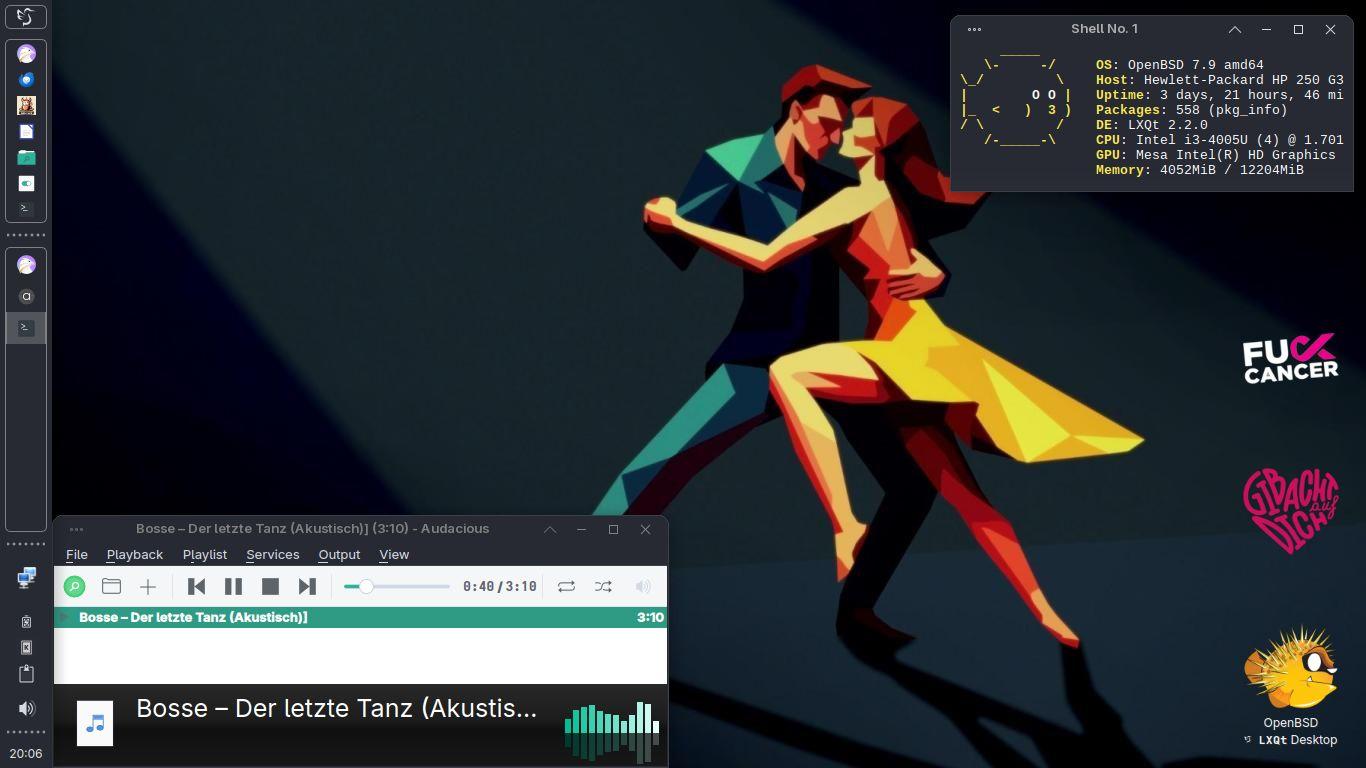
Screenshot of OpenBSD running LXQT as Desktop environment Styling: Qogir-Manjaro gtk2/3/xfwm, QT theming via qt6gtk2/qt5gtk2 LXQT Panel: Graphite Icons: Qogir-Manjaro Dancers Wallpaper by @orbite There's a panel with some pinned icons floating on the left, next to it is audacious media player and a qterminal running a minimal neofetch with some system stats is displayed in upper right corner Intellihidden: at the bottom is a floating panel with two desktop switcher buttons and at floating panel with some window action icons. In the bottom right corner there's an OpenBSD Pufferfish icon (https://logodix.com/logos/1867876) labeled with LXQT Desktop and its logo. Above are two badges with slogans dealing with cancer.
Secondary: "Tianve" - HP-250 G3
Operating System: OpenBSD 7.9 amd64
Desktop: LXQt 2.2.0
Windowmanager: XFWM4
Qt Version: 6.10.2
Graphics Platform: X11/xenocara
https://bsd-hardware.info/?probe=23dc29b97f
#runbsd #openbsd #fishlinux #unix #foss #lxqt #desktop #screenshot #shareyourdesktop
Alt...
Screenshot of OpenBSD running LXQT as Desktop environment
Styling: Qogir-Manjaro gtk2/3/xfwm, QT theming via qt6gtk2/qt5gtk2
LXQT Panel: Graphite
Icons: Qogir-Manjaro
Dancers Wallpaper by @orbite
There's a panel with some pinned icons floating on the left, next to it is audacious media player and a qterminal running a minimal neofetch with some system stats is displayed in upper right corner
Intellihidden: at the bottom is a floating panel with two desktop switcher buttons and at floating panel with some window action icons.
In the bottom right corner there's an OpenBSD Pufferfish icon (https://logodix.com/logos/1867876) labeled with LXQT Desktop and its logo. Above are two badges with slogans dealing with cancer.

#DNS #AdBlocking adventures:
- #AdGuard kinda works, but is this the cause of my occassional DNS problems?
- #Technitium dotnet, not gonna get it to work on #OpenBSD, which still has a place in my network/services
- Blocky stinks of LLMs
I guess I'm gonna end up with #unbound and cronjobs updating blocklists.

Dear BSD community,
I've got to reduce my number of books so here are some BSD related books I'd like to give away for free.
If you're in the EU and would like to have one, please reply. Can send them to you if you pay the shipping costs
#OpenBSD #BSD #FreeBSD #NetBSD

Alt...
The book of PF
Absolute OpenBSD

When I was young, one of my favorite games was Age of Empires, which was released for Windows. I haven't used Windows for a long time, but my love for the game has remained. There is a Linux port of the game called OpenAge. I began porting this game to OpenBSD in 2014; I finished the port last week, and all the patches for OpenBSD have been accepted upstream. Hooray!
I'll sent patches to ports@ soon.
https://github.com/ligurio/openbsd-wip/tree/bf0bb4502b5d890797789257fdd69799cb7e2094/games/openage

Heads up, Theo de Raadt has committed some additional tightening of setuid/setgid programs in #OpenBSD -current.
deraadt@ modified src/lib/libc/dlfcn/init.c: libc initialization now aborts if a setuid/setgid program does not have the global variable _permit_setugid declaring that it is setuid/setgid.
The more important packages have been fixed, and the long tail will be fixed by people who encounter this problem.
ok sthenderaadt@ modified src/lib/libc/dlfcn/init.c: For any binary linked against libc, compare the file setuid/setgid bits against the internal global variable _permit_setugid.
If either bit is set in the file mode, but the same bit is not set in the variable, generate a syslog message, output the same to stderr.
It looks like this: /usr/bin/x: not supposed to be setuid, aborting
[...]
More details were revealed in commits made last week laying the groundwork.
Create the weak global _permit_setugid which must match the setuid/setgid
mode of the executable file. This is documented in execve(2).If the corresponding bits are not set right, it means this binary was not intended to be setuid/setgid. The file has become setuid/setgid accidentally, unintentionally, or due to attacker control, and libc will log the event and abort.
[...]
This change in bsd.prog.mk automatically (based upon BINMODE) creates an additional .c file with the correct variable definition to compile and link into the program, so that we don't need any additional changes in userland base.
More seatbelts!


@chadmccullough @netbsd
I'm facing the same decision, if and when to leave the #AI slopified linux for greener pastures. I started with version 1.1.59 that we got by downloading 60 floppies over a dialup connection.. My last usoft OS install was NT4.0
AI is the herpes virus for software. It might be fun while getting it but it will bring a lifetime of misery.
as a starter question: what is the differences between #netBSD and #openBSD?

RE: https://mastodon.sdf.org/@netbsd/117455748417638482
During episode 132 of Linux After Dark from @latenightlinux, the hosts talked about how they could recapture the passion they once had for computers and technology. This episode got me thinking quite a lot. I've been a Linux user for more than 30 years and, admittedly, my excitement for tech was dying. Actually, it had been dying for a few years. Shitty comments from Torvalds, many projects embracing AI, and maybe even the fact that I had been using Linux for so many years, contributed to my, well, less that excited feelings about all of it. I know that I needed a change.
I may have found something that has rekindled my love and excitement. And that something is BSD. After a few months of struggling to get a BSD installed on my hardware (laptop and desktop), with the help of many here in the Fediverse over the past month or so, I finally got NetBSD installed on my laptop and desktop. It was exciting! I'm actually feeling the way I did when I first started using Linux all those years ago. I have to work a bit to get some hardware working, I have to do a lot of reading and research, and I've even joined some IRC channels and forums. Forums. Remember those?
I'm leaving Linux behind and moving on after more than 30 years. This isn't a decision that I take lightly. Quite the contrary. It's one of the hardest decisions that I've ever had to make. I spent those 30+ years preaching about how great Linux was and even moved a lot of people away from Windows to Linux and Open Source software over the years. And for a lack of a better description, I feel betrayed by the Linux kernel project and all of the open source projects who have decided to embrace AI, even with all of terrible ethical issues.
Well, anyway, I didn't write this to bash on Linux. I wrote this because I'm starting to feel excited about tech again. I may even start writing about my move from Linux BSD and how it's all going. The good things. The struggles. And everything in between.
Okay, I've put enough people to sleep with this post. I have a long road ahead of me before I feel as comfortable with BSD as I do with Linux, but I think that is where all the excitement is.
#bsd #netbsd #freebsd #openbsd #linux #noAI
Some #NetBSD questions that keep coming up.
We don't use modules for HW drivers in the default install. All baked into the kernel. If you're curious about desktop hardware, for x86 there are lists https://wiki.netbsd.org/laptops/ https://wiki.netbsd.org/gpus/ (and the pci/usb manual pages)
x86 virtual machines. https://www.netbsd.org/docs/guide/en/chap-virt.html#chap-virt-guest
For disk encryption there's different options, such as creating a small root with the installer, then adding encrypted partitions later (see man cgdconfig). Also: cgdroot.



Is there a port of Librewolf for NetBSD? It's available for OpenBSD but i don't find a binary repo (...) for NetBSD.

New local kernel exploit for #OpenBSD called #bigfish gets attackers root with KARL/SMAP/SMEP enabled, with building blocks in the chain going back ~37 years to the original BSD sources:
https://calif.io/research/big-fish
It also has really cool ANSI art. 😉
Okay, nice. Managed to lock down this #littlefedi instance a little bit more to prevent my accidentally "public" posts to be scraped via the web interface.
In my littlefedi.toml:
[web]
redirect_guests_to_about = true
And then in #OpenBSD relayd I have the following in addition to this:
# /etc/relayd.conf
# [...snip...]
http protocol "http_to_https" {
        #[... snip...]
        # Littlefedi forwards
        block request quick path pattern "^/public/local"
        pass request quick header "Host" value "0xde501a7a.net" forward to <littlefedi>
         #[...snip...]
}
This should be solid enough :)

I went to drop off a load of old crap at the computer recycling place yesterday with my #EuroBSDCon2026 T-shirt on and got asked, "Is that an #OpenBSD shirt?". I then got into the whole "How's the #BSD world? I haven't looked at it for 20 years" discussion, followed by "Is Theo still Theo?".

These two features can replace dmenu in a minimal X11 workflow:
menu-cmd searches configured commands.I documented both with practical examples:
menu-exec runs a program directly.
https://codeberg.org/r1w1s1/cwm-config/src/branch/master/cwm-quickref.md


https://rooneymcnibnug.neocities.org/openbsd_snac
Hope this might be helpful to other BSD-lovers who want a minimal-self hosted setup for Mastodon et al.