Search results for tag #programming
![[?]](https://media.phpc.social/accounts/avatars/000/000/948/original/b2c0fbf19043d758.jpg)
I hate how so many container images provide documentation only for how to use their container standlone with the docker CLI, not with docker compose.
I never want to run your container without compose. Ever. 100% of the time I want to edit a config file, not run a command with 50 switches on it. Give me the Compose instructions or GTFO.
![[?]](https://mastodon.tomodori.net/system/accounts/avatars/115/312/380/337/748/146/original/3d81bc18d653d64c.png)
[1/2] this is one crazy impressive piece of work:
/u/Heinz2001 spent *ten years* researching, disassembling, and rewriting dozens of lines of Ultima Underworld's bytecode (and underlying assembly) in order to correct an extremely goofy flaw in UW's 3d renderer.
the code and binary patch for win/linux:
https://github.com/SiENcE/uwpatch
the explanation:
Ultima Underworld used an "affine" texture mapper. to draw a brick wall stretching into the distance away from you, it draws each pixel of the texture in linear steps, by adding a textured pixel of brick for each step into the distance. because it relies on addition and subtraction to calculate distances and the number of pixels to use, it's very very fast. (if you've played PS1 games, it used this method for many games to pull off fast textured rendering too.) why addition and subtraction? because they purely rely on 2d space: x and y coordinates, and toss out the z coordinate. in effect: it's 2d rendering!
the problem with affine texture rendering is that it creates hilariously weird warpage in certain situations, especially when it comes to walls close to the camera. the left two screenshots show the warpage you get from affine calculations. when you lose the z (depth) coordinate, you lose visual accuracy.
in comes the patch: with "perspective" texture mapping, the z-coordinate (depth) is used in the calculation. this is computationally *expensive*. every time the renderer needs to determine which pixel to paint to a polygon, it must divide by 'z' three times. division kills rendering speed like you wouldn't believe, and this is why UW never used it. the target recommended machine was a 386 DX-25 mhz. the screenshots on the right show the perspective-corrected texture mapper: they look how we'd expect a wall to look.
this wikipedia entry does a perfectly cromulent job of explaining how affine and perspective texture mappers work, if you want to read some of the underlying math involved:
https://en.wikipedia.org/wiki/Texture_mapping
#ultima #retrocomputing #programming
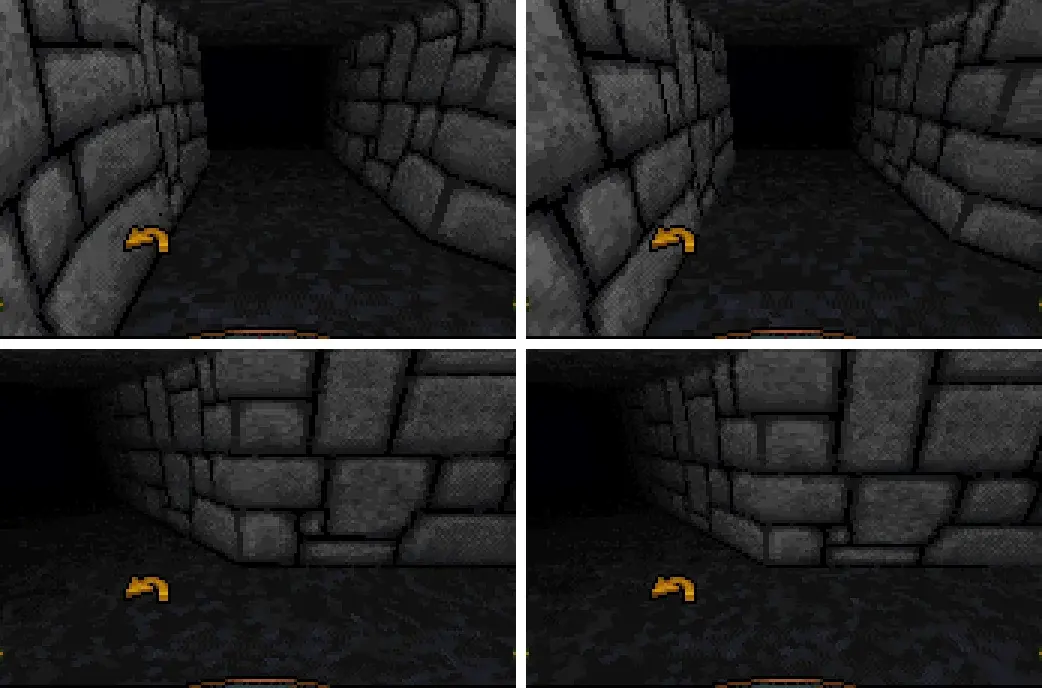
Alt...
four screenshots of Ultima Underworld, showing the different renderers used. The left photos show an affine renderer, which leaves a weird warp to the shape of the walls. Instead of being straight, they bend inwards as you approach a wall.
On the right, the game has been re-rendered using a Perspective renderer, which has no visual errors in the wall's shape. It is plumb and straight.
![[?]](https://thelemmy.club/pictrs/image/89ef1a46-6e3b-4a1e-b77e-e76155d8e98e.jpeg) bruh » 💔 🌐
bruh » 💔 🌐
@bruh@thelemmy.club
do we need documentation in the age of AI?
recently I gave AI a task to configure a software and the software didn’t have any docs of how it works only the source code. the agent went through all the files and generated a summary of how it works and why it’s not working for my particular scenario and suggested edits to my docker-compose.yml file. I couldn’t believe it since the bug was very hard to find and it used headless firefox to find why it wasn’t working.
made me realize do we still need documentation of how a software work when a AI can easily explain it?
Is 'free' costing us freedom?
How free-as-in-cost, AI-generated software and changing incentives could leave us with less control over our computers...
#Opinion #FreeSoftware #Junkstore #Programming #BryantReview
![[?]](https://mastodon.zergy.net/system/accounts/avatars/000/000/130/original/93cfc04b55d2457c.png)

Following @dragonminded post about leaving FOSS dev, I remember that someone here on Fedi told that a lot of technicians or ingineers have a kind of despise for human sciences.
As a IT tech myself I falled in this trap myself, specially on social networks as some people can be smug an annoying as they started a course in sociology (new converted theory?).
But I guess their is a relation between the two.
If as a – generally solo, and sometimes socially isolated – FOSS dev your only relations linked to your passion/interest are peoples sending you bug reports or sometimes passive-agressive comment because your program isn't good enough or not compatible with Bigcorpo© Software™ or with the latest trendy tech, you end up with only, I would said, cold and technical discussion.
People you don't know yelling at you or just asking you to fix stuff for free, specially if person asking is like “I work at Bigcorp©, we don't have monney, can you fix this hell of a bug for free?  ”
”
Don't be an asshole when doing bug report or features request, take the fact that, by default, the other person act in good faith – it can evolve as the discussion goes, sure – and give some money (if you can) and love to your FOSS dev.
Lol, guess we should make mandatory for corpos to give some money, like a fee, to FOSS projects they use.
Sorry if message if messy, I'm just a dumbfuck on the interwebs, lol, forgot to talk the AIGen slop too. 
![[?]](https://media.bsd.cafe/bsdmmedia01/accounts/avatars/112/383/904/417/926/997/original/0c88fc81b26e7fb3.jpg)
Four good books for competitive programming. The first one's PDf is a great resource if you are interested.
https://cses.fi/book/index.php
#book #programming
![[?]](https://social.moltenaether.com/system/accounts/avatars/117/355/351/360/521/045/original/e87da2f2d7edb361.png)
Here is a tightened version with every dash removed:
---
I am going to make a general response here. On another platform, I got flamed pretty hardcore by the anti-AI crowd. I am not going to debate the morality of AI itself because AI is simply a tool. In my opinion, the real culprits are the billionaires and corporations financing and steering its development.
The part that bothered me most, without offending me, was having someone who has never coded or used AI tell me that I am just a glorified typist.
First, I developed the algorithms, verified them, and worked them out on paper or in test scripts. Then I directed the AI to implement them and ensured the underlying math was correct. AI generates mediocre code at best. If you do not understand what you are reading and cannot guide the tool, mediocre code is all you will ever produce. I am in the driver's seat, directing the execution and verifying every output.
Second, I despise how AI is being deployed. Within the next five years, the bubble will likely burst, prices will spike, and access will narrow to the wealthy and major corporations. I do not support replacing workers with machines. That was always the goal pitched to early investors because machines do not have rights, feelings, or legal protections. Human labor comes with laws that limit corporate exploitation; machines do not.
Third, AI may very well contribute to global collapse. Right now it feels like a race between warmongers wanting to nuke the planet, capitalists exploiting labor and the environment, and religious extremists dragging us backward.
Finally, AI is not going anywhere, and using it is becoming mandatory for employment. Personal preferences do not matter under the economic system we inhabit. After the personal computer arrived, it took 5 to 15 years for basic computer literacy to become a baseline job requirement. ChatGPT launched in 2022. We are four years in, and that shift is already well underway.
#Coding #Programming #SoftwareEngineering #AI #DevTools #AI #GenerativeAI #AIEthics #TechEthics #FutureOfWork
It's been made clear to me that one of the reasons I was hired for this job is my boss read the README files of some of my OSS projects and was impressed at how clear and detailed a writer I am.
Just in case you thought written-English wasn't a useful skill for a developer: It got me this job. Work on your writing skills if you want to survive in tech.
Stars in my galactic star map application, generated randomly with real science and math backing them up. Still working on it.
I need to switch over to a 3D rendering library to minimize data transfer to the client to render the map. Lots, lots, lots, and lots of bugs to fix (I'm up to 120 that I've noticed myself). However, it's coming along nicely.
Yes, I used and will continue to use AI. Please don't comment about how evil it is or how I'm not really doing anything and yada yada yada. I don't care what you think. For those that want to know, I did code this, for the first 5 versions I used no AI, all the math was by hand, but as much as I studied I could not continue. I am a math teacher, not a coder, so I turned to AI to make my vision come true after going as far as I could without. As an amateur developer, I am using my math skills to research and design the algorithms before I hand off to AI for implementation and I review code by hand as well.
This is all open sourced under creative commons with attribution.
https://github.com/dwhagar/planetGen
#programming #scifi #claude #ai #galaxy #rolePlayingGames #ttrpg #rpg #ffrp #python
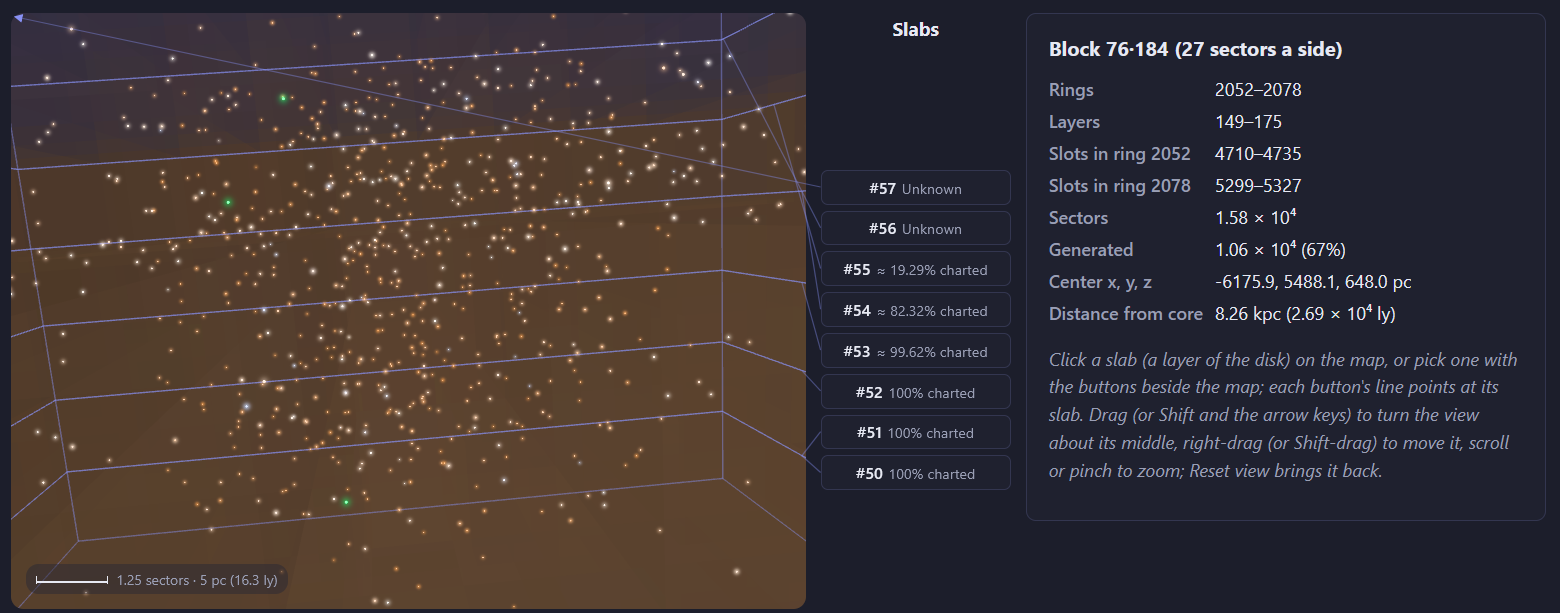
Alt...
This screenshot shows a digital 3D space-mapping interface set against a deep navy-purple background, divided into three main sections: a wireframe viewport on the left, layer controls in the center, and a data card on the right. The primary visualizer depicts a transparent, cuboid volume bounded by thin purple perspective grid lines, filled with a warm amber haze that fades toward the top. Scattered within this volume are hundreds of small, glowing starlight points, predominantly warm white and amber, with a few notable individual stars glowing bright mint green. A scale indicator in the lower-left corner indicates that the volume spans 1.25 sectors, equivalent to 5 parsecs or 16.3 light-years.
Positioned directly to the right of the viewport is a vertical column labeled "Slabs," which displays eight stacked buttons with connector lines pointing to horizontal layers inside the 3D cube. These buttons track exploration progress from bottom to top: slab number 50, slab number 51, and slab number 52 are each 100 percent charted, while slab number 53 is approximately 99.62 percent charted, slab number 54 is approximately 82.32 percent charted, and slab number 55 is approximately 19.29 percent charted. The top two layers, slab number 56 and slab number 57, are both listed as "Unknown".
The right side of the screen features a dark panel with technical metrics for "Block 76-184 (27 sectors a side)". It details Rings spanning 2052 to 2078, Layers from 149 to 175, Slots in ring 2052 from 4710 to 4735, and Slots in ring 2078 from 5299 to 5327. Total sectors are given as 1.58 times 10 to the 4th power (15,800 sectors), with 1.06 times 10 to the 4th power generated, indicating 67 percent completion. Center coordinates along the x, y, and z axes are negative 6175.9, 5488.1, and 648.0 parsecs, with a distance from the core of 8.26 kiloparsecs, or 2.69 times 10 to the 4th power light-years. The panel concludes with italicized instructions explaining that users can click a slab on the map or select a button beside it, drag or use Shift plus the arrow keys to rotate, right-drag or Shift-drag to move, scroll or pinch to zoom, and select "Reset view" to restore the default perspective.
![[?]](https://landofooo.social/fileserver/01NJ8NHSCJTSJC3J534PSTWZ70/attachment/original/01M3FYB4HT24Y89Z8E6FJG0ZNF.jpeg)

Everyone is using LLMs for the things they have no fucking idea how to do.
Designers use them to code.
Coders use them to design.
Marketers use them to design and to code.
And everyone, apparently, uses them to write.
Then the same people get furious when outsiders invade their field without the experience to back it up. And they're right. They just forget it applies to them too.
Handoffs are desirable, and they need to stay. The one-man orchestra is a delusion pushed by Big Tech, and it only leads to mediocrity. If you don't know how to do something, rely on someone who does. That's how it has always worked, and no tech giant gets to break that natural order.
Not knowing how to do something is fine. What's not fine is leaning on a machine built on the stolen work of people who actually know how, without paying them a cent, burning the planet in the process, and turning yourself into a complete moron along the way.
#AI #LLM #LLMs #Labor #Labour #Deskilling #Cognition #Environment #Writing #Coding #Programming #Marketing
![[?]](https://media.bsd.cafe/bsdmmedia01/accounts/avatars/113/813/436/485/094/756/original/f283349acf4f7492.jpg)
This is a very informative read on kernel bug fixing in 2026
Kernel Recipes 2026 - Security in the LLM age
Getting ready for my next phase of development for my galaxy generator. I'm going to next develop an algorithm to generate the tech level (TL) of a technological civilization and also calculate a habitability index for worlds. Now this is of course mostly for game mechanics reasons but I want it based as much in science with a nod to established SciFi as possible. Here's the research docs.
https://github.com/dwhagar/planetGen/commit/8ff36596d87fc1fa75c3eea20cd00052391c6b2a
#programming #scifi #science #sciencefiction #python #rp #rolePlayingGames #ffrp #ttrpg #math #physics #astrophysics
![[?]](data:image/png;base64, iVBORw0KGgoAAAANSUhEUgAAAEAAAABAAQAAAACCEkxzAAAAUUlEQVQoz43R0QkAMQwCUDdw/y3dwEvsvzlL4X1IoQkAisKmwfAFT3RgJHbQezpSRoXEqeqCL9BJBf7h3QbOCCxV5EVWMEMwG7K1/WODtlvxAYTtEsDU9F34AAAAAElFTkSuQmCC)
I am seeking an e-mail client with the following features. I was happily using Thunderbird 78 and 102, but the former keeps quitting unexpectedly in Windows 10, 11, and even 7, where it never did before! 102 is tolerable, but anything after that is a mess.
1. Must work with NVDA screen reader. I've tried several supposedly simple programs, but they were all inaccessible.
2. Must have standard menus, accessible via the alt and arrow keys as well as hotkeys for sending, replying, forwarding, etc. I want something with a clean interface as well, not cluttered like Thunderbird 115 and later.
3. Must work with Windows 7. It is my preferred operating system and I will not waste time arguing about it.
4. Must be able to read and reply to messages without downloading them. Thunderbird has this feature. Essentially, the work is done on the server via the client.
5. Must be able to search the bodies of e-mails. For some reason, Thunderbird 115 and probably higher appears to lack this important feature.
6. Must work with GMail, preferably natively, but app passwords are also fine. This is the main reason I am even using a client. Yahoo has a wonderful Basic HTML version, but Gmail does not.
7. I don't need other features aside from the normal functions of an e-mail client i.e. send, receive, allow for multiple accounts with separate inboxes, spell-checking (optional), signature (optional), and sound alerts (optional but preferred). I don't use other services that I need to connect with my e-mail client i.e. cloud, calendar, contacts, meeting platforms, etc. I also neither need nor want ai features in such a program.
#accessibility #blind #email #e-mail #GMail #NVDA #programming #technology #Windows7
![[?]](https://media.bsd.network/accounts/avatars/000/000/523/original/6403f8fe387cd11e.png)